SECOPTA SlagLIBS: Fast At-Line Slag and Ferroalloy Analysis
SlagLIBS analyzes heterogeneous materials — metallurgical slag, ferroalloys, and battery black mass — with virtually no sample preparation. Samples are simply crushed; full composition, including basicity-defining elements and fluorine, is available in under two minutes, run by the line operator right next to the furnace or integrated into an automated process lab.
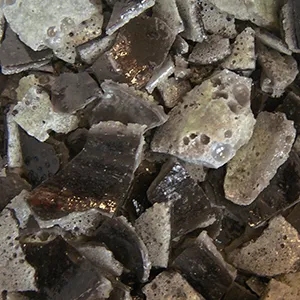
Today’s slag analysis depends on producing homogenized samples — grinding, demetallization, and pressing or fusing. That takes expensive equipment and manual labor, and it means 7 to 30 minutes of throughput time for every analysis. Optimizing metallurgical treatment on that timescale is only possible to a limited extent; in the worst case you lose time, material, and refractory.
SlagLIBS turns the problem around: with up to 1,000 analysis values per second it homogenizes the measurement data instead of the sample. Every type of slag can be analyzed in under two minutes with one device, and manual work is only needed if loading is not automated. Elements such as Ca, Fe, Al, Si, Mg, Mn, F, Cr, Ti, and V are measured in a single run — so basicity and fluorine come back together, without extra wet chemistry and without extending the measurement time.
The system is industry-proven and adapted to the needs of steel and metal production: a maintenance-free high-repetition-rate laser, a robust spectrometer design, and a calibration and software package that delivers reliable results with maximum stability. It works on user levels from operator (enter a sample number) to LIBS professional (set every parameter), ships with your process-specific slag calibration and training, and SECOPTA can update the calibration remotely as slag compositions change. Software tools check measuring-equipment capability in a few clicks for audits.
Process slag analysis: LF, EAF, AOD, and BF slags in under 1–2 minutes — instant results at every stage of melting, alloying, and metallurgical treatment for tighter basicity and yield-loss control, better foaming-slag control, optimal use of slag formers, higher metal cleanliness, shorter tap-to-tap times, and longer refractory life.
Incoming goods inspection: Check ferroalloys and other incoming material on arrival — every truckload or big bag — and reject off-spec deliveries on the spot. Use the results to meter furnace charges precisely and reduce re-alloying.
Battery recycling: Black-mass analysis in under a minute. LIBS measures not only metals but also lithium, carbon, and fluorine to give the full chemical composition, so the recycling process can be controlled and adjusted without delay.
Where it lives: Placed in the LMF or EAF pulpit and run by the operator, or integrated into an automated process lab with automatic result transfer to Level 2. No ionizing radiation. Users report a minimum of 5 minutes saved per analysis and annual savings of over €350,000.
For real-time measurement directly on a conveyor belt, SECOPTA also offers MineralLIBS.
- System dimensions (W × L × H): 500 mm × 710 mm × 1290 mm
- Weight: ~150 kg
- Power supply: 230 V, 50/60 Hz, max. 1 kW
- Laser safety: Class 1
- Protection class: IP 50
- Temperature range: +5 °C to +40 °C
- Purging gas: Compressed air · Dust evacuation prepared
- Communication: Profinet, Ethernet/IP, EtherCAT, Modbus TCP, TCP/IP, UDP, OPC UA, SQL (other protocols and fieldbus systems on request)
- Reported oxides / elements: CaO, MgO, SiO₂, Al₂O₃, FeO, MnO, Cr₂O₃, TiO₂, F, V₂O₅ — basicity-defining elements and more
- Analysis time: Results in under 2 minutes; process slag in under 1 minute
- Options: Additional elements (fluorine, chromium and more — usually possible after delivery) · Calibration extension on site or by remote service · Remote service · Service contracts · Major spare parts on stock · Measurement-system capability analysis for audits and certification
How LIBS slag analysis works, advantages, and full technical specifications.
How SlagLIBS optimizes processes at a forgings producer — hosted by SECOPTA.
Videos, application notes, and further reading on secopta.com.