

Reviewed by Andrew Oriss, Quality Coordinator, Verichek Technical Services.
Scrap metal recycling turns end-of-life metal into feedstock for new metal in five steps: collection, separation and preparation, melting and purification, solidification, and manufacturing. For a scrap yard, separation is the step that has the greatest impact on profit margins. Metal that is sorted by type and graded by alloy chemistry sells for more than mixed scrap, and it keeps off-grade material out of the mill’s melt.
This guide covers each step, the tools yards use to sort ferrous and non-ferrous scrap, and how handheld analyzers grade alloys that look identical on the pile.
Additional Reading: 5 Quick Tips For Collecting And Getting More Value Out Of Your Scrap Metal
The 5 Steps of the Scrap Metal Recycling Process
Step 1: Collection
The first step in scrap metal recycling is collecting items that contain metals. Most of the volume comes from demolition and construction sites, manufacturing offcuts and turnings, auto salvage, industrial plants, and obsolete equipment and appliances.
Step 2: Separation & Preparation
At the recycling facility, material is sorted by metal type and grade. Then, it’s sized and packaged for transport by shredding, shearing, baling, and compacting. Sorting happens in layers:
- Magnets and magnetic drums pull ferrous steel and iron out of the stream.
- Eddy current separators push non-ferrous metals such as aluminum and copper away from non-metallic material.
- Density (sink-float) separation and optical sorting split mixed non-ferrous fractions by weight and color.
- Handheld XRF and LIBS analyzers identify alloy grades, such as 304 versus 316 stainless, that no magnet or camera can tell apart. See how scrap yards grade and verify alloys in the section below.
Step 3: Melting & Purification
After separation, the scrap is melted down and purified by steel mills, foundries, and smelters to remove impurities. Mills confirm melt chemistry with spark optical emission spectrometry (OES) before the metal is poured, which is why the grade a yard ships needs to match the grade it was sold as.
Step 4: Solidification
The metal is cooled and formed into different shapes for future use.
Step 5: Manufacturing
The new metal is now ready for use by manufacturers, who turn it into new products. The volumes are large. American steelmaking furnaces consume nearly 70 million tons of domestic steel scrap each year, according to the American Iron and Steel Institute, and recycled aluminum takes about 5 percent of the energy needed to make new aluminum from bauxite, according to the Aluminum Association.
Large businesses with in-house programs and scrap yards often bring in third-party technical services to help sort and grade their scrap. They either send material to the service provider or have a technician come to the site to run positive material identification (PMI) tests, which help identify and sort mixed scrap by alloy grade.
Businesses with trained staff often buy their own metal analyzers to sort scrap in-house.
Analyzers Yards Use to Sort and Grade Scrap Metal
GNR E3 Esaport Portable OES Analyzer
The GNR E3 Esaport is a compact portable optical emission spectrometer with arc and spark excitation. It brings lab-comparable chemistry, including carbon, to on-site PMI and scrap sorting, for yards and processors that need to confirm steel grades before material ships to a mill.
Hitachi Vulcan Handheld Metal Analyzer
Hitachi’s Vulcan handheld LIBS analyzer (laser-induced breakdown spectroscopy) returns a grade ID in about one second per trigger pull, from a library of up to 1,500 pre-installed grades (AISI, DIN, JIS, and GB). It is IP54 rated and MIL-STD-810G compliant for yard conditions, and because it uses a laser instead of X-rays, it needs no radiation license. LIBS also reads light elements such as magnesium and silicon, which makes it a strong fit for separating aluminum grades.
Hitachi X-Met8000 Handheld XRF Analyzer
Hitachi’s X-MET8000 handheld X-ray fluorescence (HHXRF) analyzer delivers fast, nondestructive alloy chemistry on solid metal. In a scrap yard, it’s the everyday tool for grading stainless steel, nickel alloys, and copper alloys, drawing from a library of more than 1,600 alloy grades.
Tools of the Trade for Sorting Scrap Metal
Shredders, shears, balers, and radiation portal monitors handle the volume at a recycling plant. But getting each load into the right grade still comes down to four tools at the scale house and on the pile.
1. A Magnet for Identifying and Assessing Metal Value

A magnet is one of the first tools used to sort scrap metal in every yard. It helps separate ferrous from non-ferrous metals. Here’s what to look for:
- If the magnet sticks, the metal is likely ferrous. Carbon steel and cast iron fall under this category. Ferrous scrap is high volume and low value per pound, but every yard accepts it.
- If the magnet doesn’t stick, the metal may be non-ferrous. Copper, brass, and aluminum are non-ferrous, and they are worth more per pound than ferrous scrap because they resist corrosion, conduct better, and weigh less.
Keep in mind: common stainless grades such as 304 and 316 are non-magnetic or only weakly magnetic, so a magnet alone may incorrectly classify them as non-ferrous. It also can’t tell one stainless or aluminum alloy from another. This takes an analyzer.
2. Containers For Sorting

Keep a separate bin for every metal and grade you handle. Mixed loads either get sent back for sorting or are paid for at the price of the least valuable metal in the bunch, and a mill that finds off-grade material in a shipment can downgrade or reject the load.
Here’s an example: a copper load with aluminum mixed in gets paid at the aluminum price, and a 316 stainless load with a few 304 pieces in it gets paid as 304. The lowest grade in the bin can determine the price of the entire load.
3. A Grinder or File for a Clean Test Surface
Paint, plating, oxide, and dirt hide the metal underneath and throw off both visual ID and analyzer readings. Grind or file a small spot down to bright metal before you judge color or take a reading.
4. A Handheld Analyzer for Alloy Grades
When the grade matters, a handheld XRF or LIBS analyzer reads the alloy chemistry in seconds. See how scrap yards grade and verify alloys below, or compare models in our guide to the best handheld metal analyzer.
What are the Different Types of Recyclable Metals?
Ferrous Metals
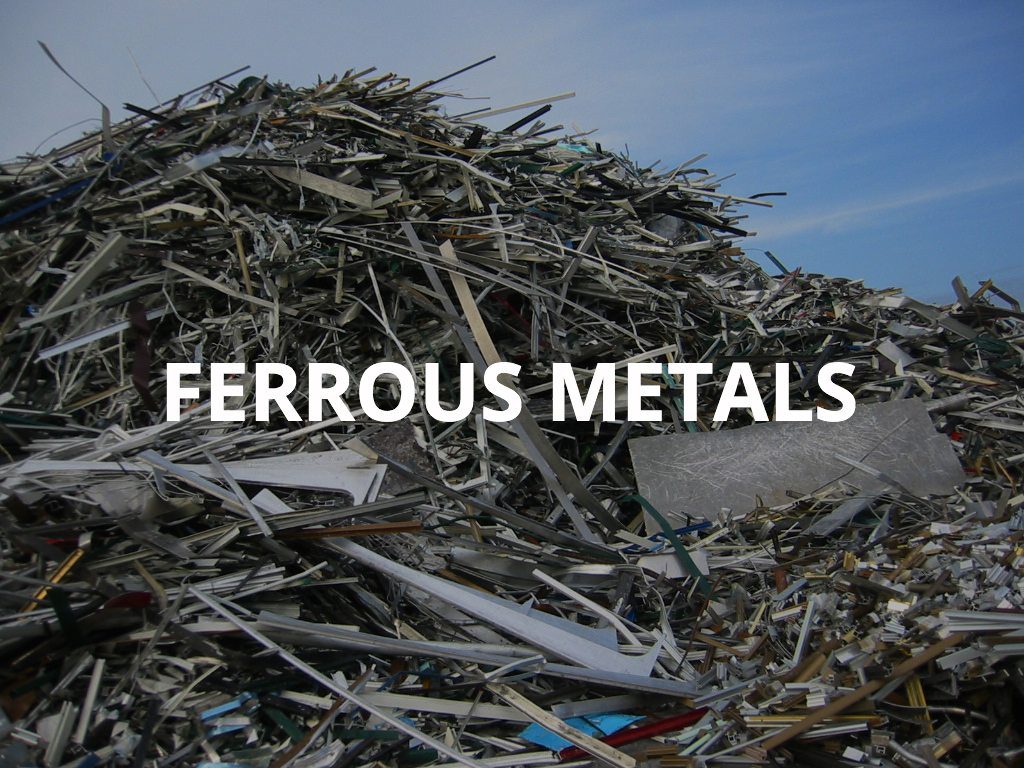
- Steel sticks firmly to a magnet. It’s the highest-volume scrap stream and one of the lowest in value per pound, found in everything from structural beams and rebar to car bodies and appliances.
- Iron is also magnetic. Yards use magnet-fitted cranes to move iron scrap around. Iron is one of the most recycled metals on the planet partly because it’s straightforward to reprocess. Cast iron comes in as machinery bases, engine blocks, pipe, and boilers.
- Stainless steel is iron-based, so it’s technically ferrous. But yards trade it as its own category because its chromium, nickel, and molybdenum content drives the price. Austenitic 300-series grades such as 304 and 316 are non-magnetic or only weakly magnetic, which is why they get mistaken for non-ferrous metals. Ferritic and martensitic 400-series grades are magnetic. Separating 304 from 316 takes an analyzer since the main difference is roughly 2 to 3 percent molybdenum. You’ll find stainless in food and chemical processing equipment, kitchenware, appliances, and automotive and aerospace parts.
Non-Ferrous Metals
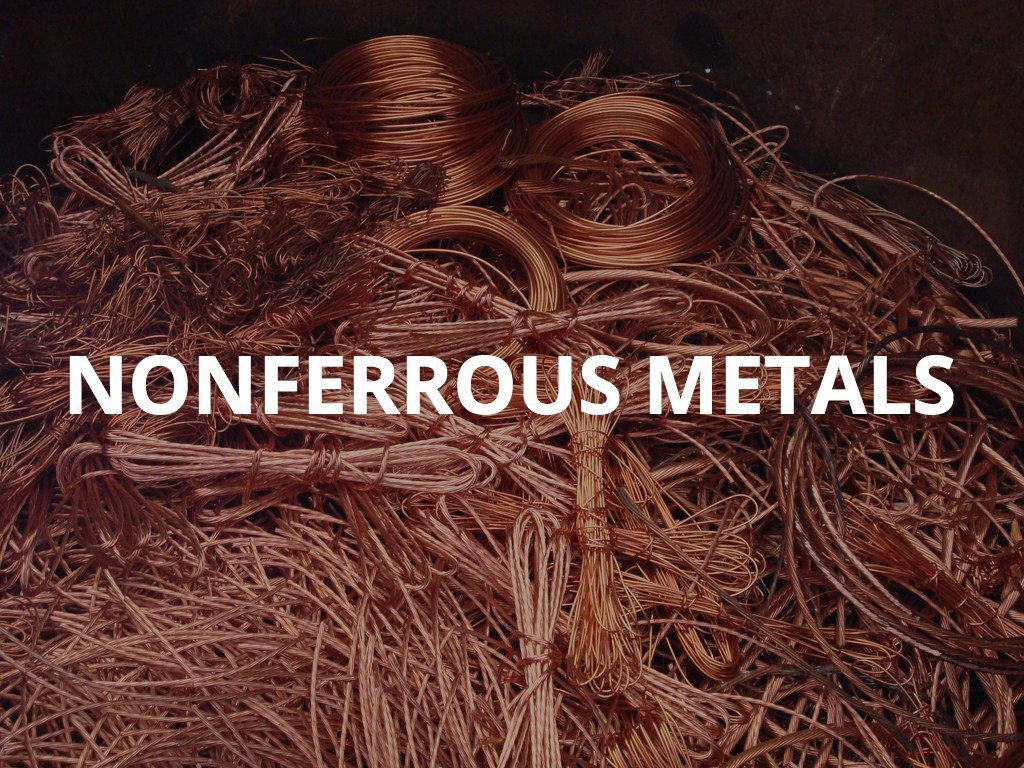
- Copper is one of the highest-value streams in a non-ferrous yard. It has a reddish color when in good condition, but it can have a dark brown appearance when worn. It comes in as wire and cable, power cords, plumbing pipe, motors, and electromagnets. Yards grade it by purity and cleanliness, so stripped, unplated copper is worth more than insulated or soldered material.
- Aluminum may look like steel, but it won’t stick to a magnet. It comes in as extrusions, sheet, castings, wheels, and auto parts. Used beverage cans are classified as a separate grade, and yards keep cast, extruded, and sheet aluminum apart because the each category has a different scrap value.
- Brass is a combination of zinc and copper and is common in valves, fittings, plumbing hardware, and machined parts. This heavy metal has a yellowish color (with a touch of red), but often takes a greenish appearance when left outside for a prolonged period of time.
- Bronze is copper alloyed mainly with tin, sometimes with aluminum, manganese, silicon, or nickel. It’s hard to distinguish from brass by appearance; an XRF reading, however, identifies it in seconds.
- Lead is soft, heavy, and corrosion resistant. It comes in as wheel weights, pipe, sheet, and cable sheathing. Yards keep it separate because of its handling requirements.
Good To Know: Advanced Scrap Metal Identification Methods
Appearance and a magnet can help narrow down the metal type. For alloy grades, yards, mills, and metal workers rely on these methods:
- OES: An optical emission spectrometer uses an arc or spark to excite atoms at the metal’s surface and then measures the light they emit to quantify each element, including carbon, sulfur, and phosphorus. Spark OES is the lab and melt-shop standard for steel chemistry (for example ASTM E415 for carbon and low-alloy steel). Read more on how spectroscopy and spectrometry differ.
- XRF: X-ray fluorescence directs X-rays from a tube onto the sample. Each element in the metal emits secondary (fluorescent) X-rays at its own energy, and the analyzer reads those to calculate the alloy chemistry.
- LIBS: This method is popular in scrap analysis and uses a high-energy laser pulse to analyze metals in seconds, including light elements that handheld XRF struggles with.
- Spark test: This test uses a high-speed grinder to generate a stream of sparks. The metal worker inspects the color, length, and pattern of the sparks to help identify the metal.
- Rockwell test: Using a testing machine with a cone-shaped point, the Rockwell test measures a material’s hardness to distinguish the type. The downside is that it considers only one of a metal’s many properties.
For more techniques and their pros and cons, see our guide on how to identify metals.
How Scrap Yards Grade and Verify Alloys
A magnet sorts ferrous from non-ferrous metals. Determining whether a load sells as 316 stainless or mixed stainless, or as 6061 aluminum or mixed clips, requires analyzing its chemical composition. Most yards grade with handheld XRF, LIBS, or both, and mills confirm melt chemistry with spark OES.
Handheld XRF for Stainless, Nickel Alloys, and Red Metals
Handheld XRF is the workhorse for grading stainless steel, nickel and cobalt alloys, titanium, and copper alloys such as brass and bronze. A reading takes a few seconds, and the sample is left intact. It’s main limitation is measuring light elements: handheld XRF cannot measure carbon, lithium, or beryllium, and it reads magnesium, aluminum, and silicon with less precision than heavier elements. This makes it less effective for grading aluminum alloys and unable to distinguish between low-carbon “L” grades.
Handheld LIBS for Aluminum and Light Elements
Handheld LIBS fires a laser pulse at the surface and reads the light from the resulting plasma. It measures the light elements XRF struggles with, which makes it the stronger choice for sorting aluminum alloys by series. Some LIBS models are built to measure carbon in steel; check the specification if carbon matters to your buyers. LIBS uses no X-rays, so it doesn’t require X-Ray equipment registration.
304 vs 316: Why a Magnet Won’t Do
304 and 316 stainless look the same, and both are non-magnetic or only weakly magnetic. The difference is molybdenum: 316 carries roughly 2 to 3 percent and 304 carries essentially none. Molybdenum raises the value, so shipping 316 as 304 leaves money on the table, and shipping 304 as 316 can get a load downgraded. An XRF or LIBS reading can tell them apart in seconds.
Spark OES When the Chemistry Has to Hold Up
Spark OES is the reference method at mills and foundries, as well as for any job that needs carbon, sulfur, phosphorus, or nitrogen quantified. Portable arc/spark OES analyzers such as the GNR E3 Esaport bring that capability to the yard for steel grades where carbon content affects the price or determines whether the material meets a customer’s specifications.
At a glance:
| Method | Best for in a scrap yard | Light elements (Mg, Al, Si) | Carbon | Speed |
|---|---|---|---|---|
| Handheld XRF | Stainless, nickel alloys, titanium, copper alloys | Limited precision | No | A few seconds |
| Handheld LIBS | Aluminum alloys by series, light-element grades | Yes | Select models only | About one second |
| Spark OES (portable or lab) | Carbon and low-alloy steel, melt chemistry | Yes | Yes | Tens of seconds per burn |
Keep Unknowns Separate and Analyzers Verified
Material that won’t read cleanly or reads between grades, goes in its own bin until it is identified. Mixing a questionable piece into a graded load risks downgrading or rejecting the whole load. Run a check sample of known composition at the start of each shift so that drift shows up before it costs money, and be sure to keep the analyzer on a regular service and certification schedule.
Outsourcing PMI When You Don’t Own an Analyzer
Yards and processors that grade occasionally or need a third-party result for a customer can bring in positive material identification (PMI) testing on site instead of buying equipment. For help choosing between the two, see buy, rent, or outsource PMI equipment and our guide to sorting scrap metal.
Yards that grade every day usually come out ahead owning an analyzer. A certified used instrument can lower the upfront cost, while a lease or finance plan can spread payments over time. Meanwhile, the analyzer earns its keep on every graded load, and a regular certification schedule keeps its readings defensible when a buyer disputes a grade.
Talk to a Verichek metal testing specialist about analyzers, certification, or on-site PMI for your yard.
Recycled Scrap Metal Prices and Value
Scrap prices shift daily with commodity markets and regional demand, but three things are within a yard’s control: grade, cleanliness, and chemistry.
Clean, segregated, correctly graded material can command a better price. Mixed, dirty, or misgraded loads may be discounted, downgraded, or rejected by the buyer.
This is why grading pays for itself on high-value streams. Confirming that a bin of stainless is 316 rather than 304, or that a pile of copper alloy is bronze rather than brass, can affect its price. For current prices, check a live source such as Scrap Monster.
Handheld Analyzer Safety
Handheld XRF analyzers emit X-rays when the trigger is pulled. For this reason, operators should complete the manufacturer’s radiation safety training, never point the analyzer at a person, and follow their state’s registration rules for X-ray devices. LIBS analyzers use a laser instead, which calls for laser safety training and eye protection per the manufacturer. Verichek offers operator training for both.
Sorters testing scrap metal on the pile still need the yard’s standard PPE: cut-resistant gloves, safety glasses, safety-toe boots, and a hard hat anywhere near cranes and grapples.
Frequently Asked Questions
How do scrap yards separate metals?
In stages. Magnets pull out ferrous steel and iron first. Eddy current separators then kick non-ferrous metals, such as aluminum and copper, out of mixed streams, and density (sink-float) and optical sorting split the rest by weight and color. Alloy grades, such as 304 versus 316 stainless or 6061 versus 5052 aluminum, are separated with handheld XRF or LIBS analyzers, which can read the chemistry in seconds.
Is it worth separating scrap metal?
Yes. Yards pay by grade, and a mixed load is usually paid at the lowest-value metal in it or downgraded. Keeping copper, brass, aluminum, stainless, and steel in separate bins, as well as keeping them free of plastic, insulation, and dirt, is the simplest way to get full value for each grade.
How can you tell different scrap metals apart?
Start with a magnet and appearance: ferrous metals stick, and color separates copper, brass, and aluminum. A magnet can’t tell stainless grades or aluminum alloys apart, though. For grade-level identification, yards use handheld XRF or LIBS analyzers, and mills confirm melt chemistry with spark optical emission spectrometry.
How is stainless steel graded for scrap?
By chemistry. Stainless is valued on its nickel, chromium, and molybdenum content, so yards sort it by grade family (for example 304, 316, and 400-series) rather than by look. 304 and 316 are hard to tell apart without an analyzer because the main difference is roughly 2 to 3 percent molybdenum in 316.
What metal can you not scrap?
Most yards refuse radioactive or radiation-contaminated material, which is why inbound loads cross radiation portal monitors at the scale. They also turn away sealed or pressurized containers such as unpurged gas cylinders and propane tanks, along with material contaminated with hazardous fluids. State laws add seller ID and record-keeping rules for catalytic converters, utility and rail material, and other commonly stolen items, so each yard’s acceptance policy is determined by its state.
Need alloy grades you can stand behind? Talk to a Verichek metal testing specialist about handheld XRF and LIBS analyzers, analyzer certification, or on-site PMI testing.